Introduction
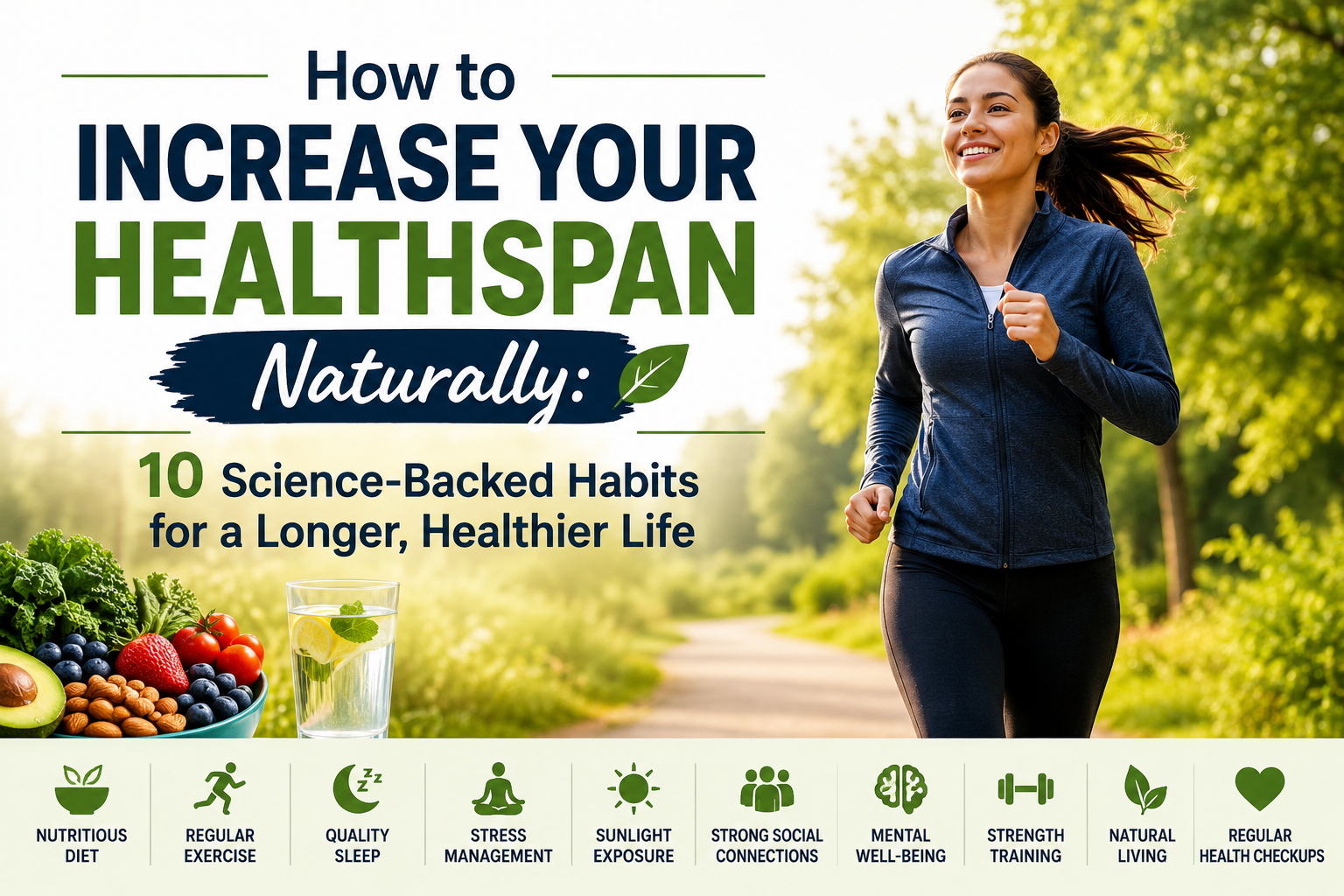
Most people want to live a long life — but what’s the point of adding years if those extra years are spent battling chronic illness, low energy, or cognitive decline? That’s the difference between lifespan and healthspan.Your healthspan is the number of years you live in good health — physically capable, mentally sharp, and emotionally thriving. And here’s the exciting part: science now shows that how long you stay healthy is largely within your control.In this guide, you’ll discover how to increase your healthspan naturally, starting today — no expensive supplements, no extreme interventions required.
What Is Healthspan and Why Does It Matter?
Lifespan measures how long you live. Healthspan measures how well you live.
According to data from the World Health Organization, the average person spends the last 8–10 years of their life managing one or more serious chronic conditions. The goal isn’t just to add birthdays to your life — it’s to add life to your birthdays.
The good news? Researchers at Harvard, Stanford, and the National Institutes of Health have identified specific, repeatable habits that can significantly extend your healthspan — and most of them cost nothing.
10 Science-Backed Habits to Naturally Increase Your Healthspan
1. Prioritize Zone 2 Cardio Training
Zone 2 cardio — steady, conversational-pace exercise where you can still hold a conversation — is one of the most powerful tools for longevity. It trains your mitochondria (the energy factories in your cells), improves insulin sensitivity, and reduces inflammation.
What the science says: A 2022 study in the Journal of Physiology found that regular Zone 2 training significantly improved metabolic health markers associated with longer healthspan.
How to start: Aim for 150–180 minutes per week of brisk walking, cycling, or light jogging. You should be slightly breathless but still able to talk.
2. Eat a Mostly Whole-Food, Plant-Forward Diet
You don’t need to go fully vegan, but centering your meals around vegetables, legumes, whole grains, nuts, and seeds dramatically reduces your risk of heart disease, cancer, and metabolic disorders — the biggest killers of healthspan.
What the science says: The Blue Zones research — studying populations with the highest concentration of centenarians — consistently shows that plant-forward diets with moderate protein are the common thread.
Practical tip: Follow the 80/20 rule. Eat whole, minimally processed foods 80% of the time and don’t stress about the rest.
3. Strength Train at Least Twice a Week
Muscle mass is a longevity asset. After age 30, you naturally lose 3–8% of muscle mass per decade. Less muscle means lower metabolism, weaker bones, and higher fall risk as you age.
What the science says: A study published in JAMA Network Open (2022) found that adults who strength trained at least twice weekly had a 20–30% lower risk of all-cause mortality compared to non-trainers.
How to start: Bodyweight exercises (squats, push-ups, lunges) are enough to begin. Aim for 2–3 sessions per week, progressively increasing resistance over time.
4. Optimize Your Sleep — Don’t Just Get Enough, Get Quality Sleep
Seven to nine hours of sleep is the foundation of cellular repair, immune function, memory consolidation, and hormonal balance. Sleep deprivation accelerates nearly every marker of biological aging.
What the science says: Matthew Walker’s research at UC Berkeley shows that chronic poor sleep is linked to increased amyloid plaque buildup — a key risk factor for Alzheimer’s disease.
Practical tips for better sleep:
- Keep a consistent sleep/wake schedule, even on weekends
- Keep your bedroom below 67°F (19°C)
- Avoid screens for 30–60 minutes before bed
- Limit alcohol — it fragments deep sleep stages
5. Manage Chronic Stress With Intention
Chronic stress floods your body with cortisol, which damages the hippocampus, accelerates immune aging, and shortens telomeres — the protective caps on your chromosomes that determine biological age.
What the science says: Nobel Prize-winning researcher Dr. Elizabeth Blackburn found a direct link between chronic psychological stress and telomere shortening, a biological marker of accelerated aging.
Evidence-based stress tools:
- Mindfulness meditation (even 10 minutes daily shows measurable results)
- Time in nature — shown to lower cortisol and blood pressure
- Social connection — loneliness is as harmful to health as smoking 15 cigarettes a day
- Journaling, breathwork, and regular digital detoxes
6. Time-Restrict Your Eating Window
Intermittent fasting — specifically time-restricted eating (TRE) — triggers a cellular cleanup process called autophagy, where your body breaks down and recycles damaged cells. This process is strongly linked to reduced cancer risk, improved brain health, and slower aging.
What the science says: Research from the Salk Institute shows that a 10–12 hour eating window (e.g., 8am–6pm) can improve metabolic markers, reduce inflammation, and promote longevity — even without changing what you eat.
How to start: Simply move your breakfast slightly later and dinner slightly earlier to compress your eating window to 10–12 hours.
7. Build Strong Social Connections
The Harvard Study of Adult Development — the longest-running study on happiness and health — concluded after 80+ years that the quality of your relationships is the single greatest predictor of healthy aging.
Loneliness raises cortisol, weakens the immune system, disrupts sleep, and doubles the risk of dementia. Strong social ties do the opposite.
Practical steps:
- Prioritize in-person time over digital socializing
- Join a club, class, or volunteer group
- Schedule regular time with people who energize and support you
8. Limit Alcohol and Avoid Smoking Entirely
There is no safe level of smoking for healthspan — it damages virtually every system in the body. As for alcohol, the long-held belief that moderate drinking is protective has been largely revised by more recent research.
What the science says: A landmark 2018 study in The Lancet analyzing data from 195 countries concluded: “The safest level of drinking is none.”
Even modest reduction in alcohol intake improves liver function, sleep quality, cardiovascular health, and cancer risk within weeks.
9. Get Regular Preventive Health Screenings
Extending healthspan isn’t just about healthy habits — it’s also about catching problems early. Many of the conditions that most reduce healthspan (heart disease, cancer, diabetes, hypertension) are highly treatable when detected early.
Baseline screenings to discuss with your doctor:
- Blood pressure and lipid panel (annually after 40)
- Blood glucose and HbA1c (annually after 35)
- Colonoscopy (starting at 45)
- DEXA scan for bone density (women 65+, or earlier with risk factors)
- Regular skin checks if you have significant sun exposure
10. Keep Learning and Stay Mentally Active
Cognitive reserve — the brain’s resilience against aging and disease — is built through lifelong learning, complex problem-solving, and mental stimulation. People who regularly challenge their minds show delayed onset of dementia and maintain sharper executive function into old age.
Science-backed brain habits:
- Learn a new skill or language
- Play a musical instrument
- Read regularly across diverse subjects
- Engage in strategy games, puzzles, or chess
- Maintain meaningful, intellectually stimulating conversations
The Healthspan Formula: It’s the Synergy That Counts
No single habit on this list will transform your health overnight. What’s powerful is their combined effect. Sleep supports exercise recovery. Exercise reduces stress. Good nutrition supports sleep. Social connection motivates all of the above.
Think of these habits not as a checklist but as an interconnected system — each one reinforcing the others.
Start With One Habit This Week
You don’t have to overhaul your entire life at once. The research is clear: small, consistent changes compound dramatically over time.
Pick the one habit from this list that feels most achievable and start there. Add another in a month. Within a year, you’ll have built a lifestyle that science says can meaningfully extend the years you spend in vibrant, capable, joyful health.
Your healthspan isn’t just about how long you live. It’s about how fully you live — and that starts with the choices you make today.
Frequently Asked Questions
What is the difference between lifespan and healthspan? Lifespan refers to total years lived. Healthspan refers to the years lived in good physical and mental health, free from chronic disease or disability.
Can you really increase your healthspan naturally? Yes. Large-scale research consistently shows that lifestyle habits — including diet, exercise, sleep, stress management, and social connection — are the primary drivers of how long we remain healthy.
How quickly can these habits improve my health? Some benefits begin within days (improved sleep, reduced stress). Metabolic and cardiovascular benefits typically become measurable within 8–12 weeks of consistent lifestyle changes.
Is genetics a factor in healthspan? Genetics accounts for roughly 20–30% of your healthspan, according to research from the Karolinska Institute. Environment and lifestyle choices drive the rest.
This content is for informational purposes only and does not constitute medical advice. Consult your healthcare provider before making significant changes to your diet, exercise, or health routine.
Read the latest blog here
The Secret to a Fulfilling Life