For most of the last century, the goal of medicine and public health was simple: help people live longer. And by that measure, we have succeeded enormously. But somewhere along the way, a more important question got left behind — are those extra years actually worth living? This is where the conversation around healthspan vs lifespan becomes essential. As we move further into 2026, more doctors, researchers, and everyday people are realizing that adding years to your life means very little if those years are spent battling chronic illness, fatigue, or loss of independence. Understanding the difference between these two concepts—and learning how to actively improve your healthspan—may be one of the most important health decisions you make this year.
What Is the Difference Between Healthspan and Lifespan?
—alsoLifespan is the easier of the two to understand. It simply refers to the total number of years a person lives, from birth to death — also known as life expectancy.
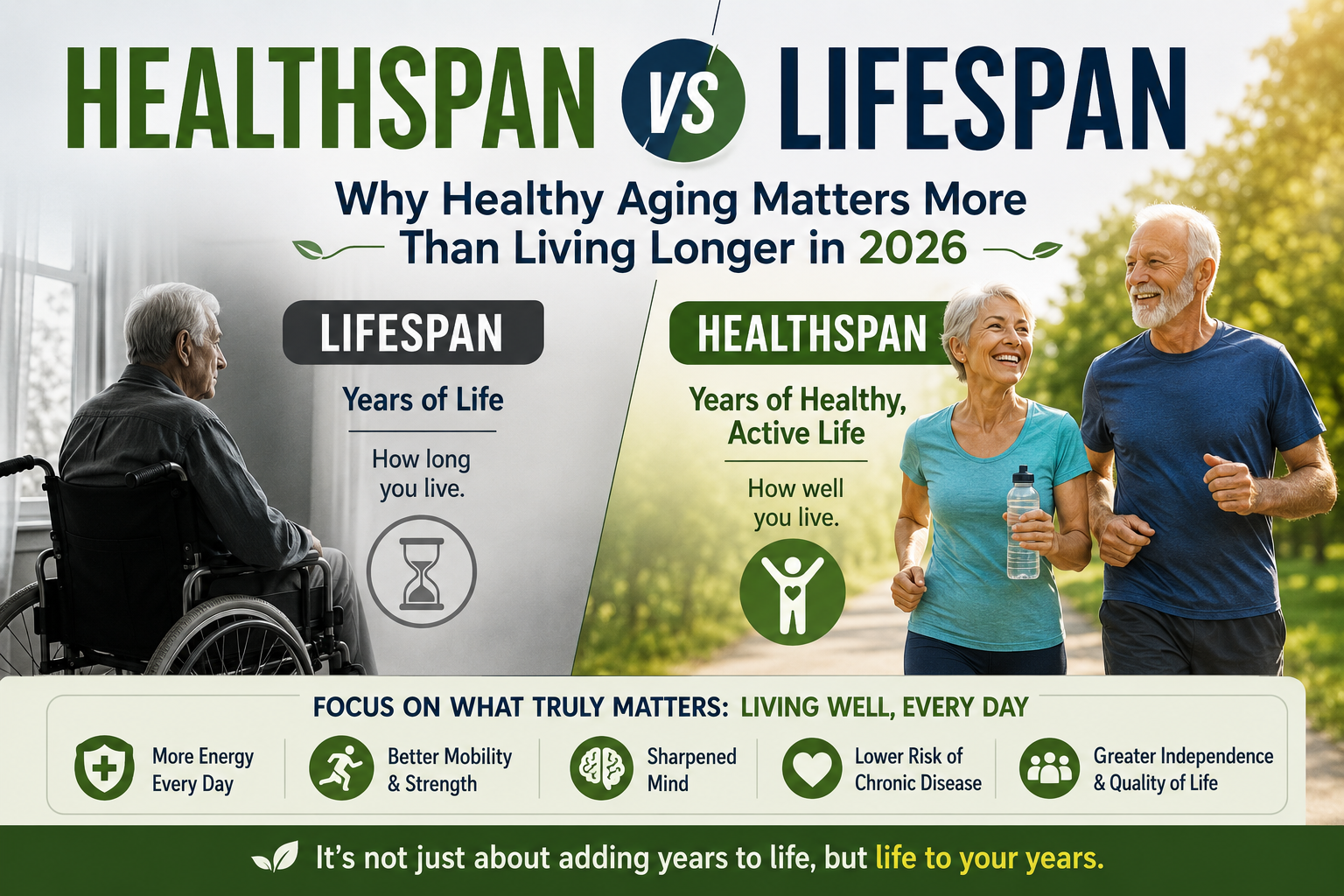
Healthspan, on the other hand, refers to the number of years a person lives in good health, free from serious chronic disease, pain, or disability. Lifespan refers to the total number of years a person lives, while healthspan refers to the number of years lived in good health without major disease.
In other words, lifespan tells you how long the candle burns. Healthspan tells you how brightly it burns the whole way through.
The Healthspan-Lifespan Gap: A Growing Global Problem
Here’s where things get concerning. Over the past century, global life expectancy has risen dramatically — from around 46 years in 1950 to roughly 73 years today. That’s an extraordinary achievement made possible by vaccines, sanitation, antibiotics, and modern medical care.
But healthy life expectancy hasn’t kept pace. In fact, in some wealthy nations, it’s actually moving in the wrong direction. Average healthy life expectancy for adults in the U.S. dropped from 65.3 years in 2000 to just 63.9 years in 2021, even as overall lifespan continued to climb.
“gap”—the The result is what researchers now call the “healthspan-lifespan gap” — the number of years people spend living with significant illness or disability before death. According to research published in JAMA, Americans now spend an average of 12.7 years living with significant functional limitations and chronic diseases. That’s more than a decade of life potentially spent dealing with mobility issues, cognitive decline, dependence on multiple medications, and reduced quality of life.
This pattern isn’t unique to the United States either. Countries such as the United Kingdom, Australia, and New Zealand are also seeing life expectancy rise while a growing share of those extra years are spent managing multiple health conditions.
Why Healthspan Matters More Than Ever in 2026
So why is this conversation gaining so much traction right now? A few reasons stand out.
1. The Science of Aging Has Advanced Dramatically
Longevity research is no longer just about lifestyle advice — it’s increasingly about understanding what happens inside our cells as we age. Scientists are now studying mitochondrial decline, “zombie” senescent cells that stop dividing but refuse to die, and the breakdown of the body’s natural waste-clearing systems. Together, these processes drive much of what we experience as aging.
“IL-11″A landmark study found that blocking a single protein called IL-11 extended mouse lifespan by roughly 25 percent while also improving metabolism, muscle function, and frailty markers—a strong signal that the biological mechanisms behind aging can be influenced, not just managed.
—For2. “Healthspan” Has Become the New Buzzword — For Good Reason
—aHealth experts are deliberately moving away from terms like “anti-aging,” which imply fighting an unwinnable battle, toward “healthspan” — a term that reflects a more realistic and motivating goal. As one longevity-focused physician put it, the shift toward healthspan reflects a focus on the years you spend actually feeling good, not just alive.
3. The Gap Is Measurable — And Growing
—andA 2025 study published in Communications Medicine mapped the healthspan-lifespan gap across 183 countries, using data from the World Health Organization, the United Nations, and global health expenditure databases. The research found that longevity gains have not been matched by equivalent improvements in healthy longevity, creating a measurable healthspan-lifespan gap that varies significantly by region — and is projected to persist for decades without meaningful intervention.
How to Improve Your Healthspan Naturally
The encouraging news is that healthspan isn’t entirely determined by genetics or luck. While you can’t control everything, research consistently points to a handful of lifestyle factors that have an outsized impact on how many of your years are spent in good health.
1. Prioritize strength and mobility, not just cardio. Maintaining muscle mass and joint mobility is one of the strongest predictors of independence in later life. Resistance training two to three times a week helps preserve the strength needed for everyday activities well into older age.
2. Treat sleep as a non-negotiable. Poor sleep accelerates almost every marker of biological aging, from inflammation to metabolic health. Aiming for consistent, quality sleep is one of the simplest ways to protect your healthspan.
3. Focus on metabolic health. Blood sugar regulation, healthy cholesterol levels, and maintaining a stable weight all reduce the risk of the chronic diseases that account for most of the healthspan-lifespan gap, including heart disease, type 2 diabetes, and certain cancers.
—both4. Don’t underestimate social connection. Strong relationships and a sense of purpose are consistently linked to better cognitive health and lower rates of depression in older adults — both critical components of a long healthspan.
5. Get curious about your biological age. Tools that estimate biological age based on bloodwork, fitness markers, and lifestyle habits can offer a more meaningful picture of your health trajectory than your birth certificate alone. Many people are now using these tools to track progress and stay motivated.
—often6. Catch problems early. Regular check-ups, screenings, and bloodwork can help identify the early warning signs of chronic disease — often years before symptoms appear—giving you a much better chance of reversing or slowing the process.
Healthspan vs Lifespan: Which Should You Focus On?
—The truth is, this isn’t really an either-or question. Most people don’t actually want to live forever — they want to live well for as long as possible and then experience a relatively quick decline rather than a prolonged one.
That’s the real promise of focusing on healthspan: not necessarily adding more candles to the cake, but making sure the years you do have are filled with energy, mobility, clarity, and independence.
The Bottom Line
The debate of healthspan vs lifespan isn’t just an academic one — it’s a framework that can reshape how you think about your own health choices in 2026 and beyond. Living longer is no longer the finish line. Living better, for longer, is the real goal.
By focusing on strength, sleep, metabolic health, social connection, and early detection, you’re not just adding years to your life — you’re adding life to your years. And in a world where the gap between lifespan and healthspan continues to widen for so many people, that shift in mindset might be the most valuable health decision you make this year.
Read the latest blog here
How to Increase Your Healthspan Naturally: 10 Science-Backed Habits for a Longer, Healthier Life