Introduction: A Name for the Unknown
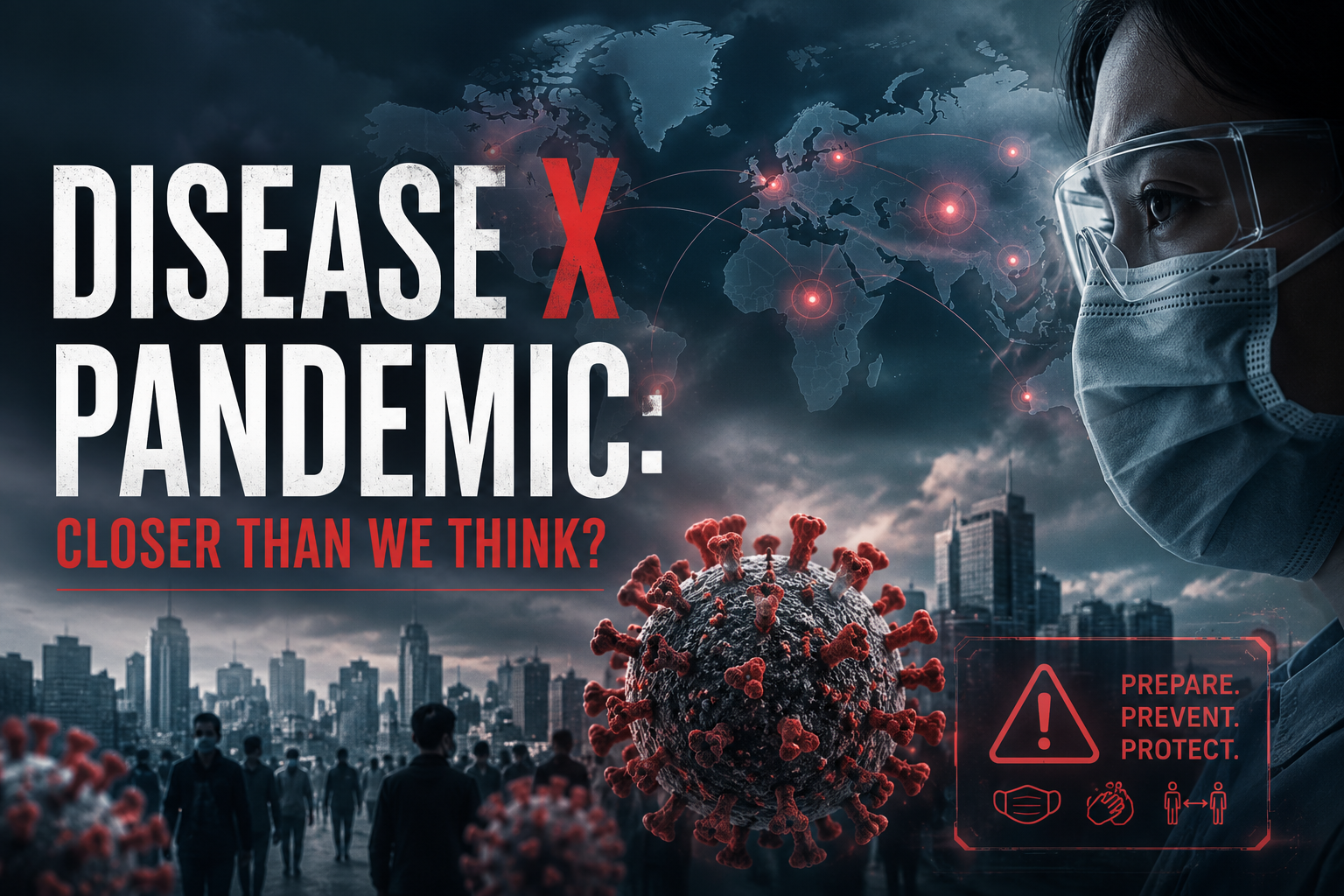
In 2018, the World Health Organization did something unusual — it added a mystery to its list of priority diseases. Alongside Ebola, SARS, and Zika sat a placeholder: Disease X Pandemic. Not a real illness, but a deliberate reminder that the next global health catastrophe could come from a pathogen we’ve never seen before.
Fast forward to today, and Disease X is no longer just a theoretical footnote. Virologists, epidemiologists, and global health officials are sounding louder alarms than ever. With climate change, deforestation, and expanding human-animal contact reshaping our biological landscape, the question isn’t really if a Disease X pandemic will happen — it’s when, and whether we’ll be ready.
What Exactly Is Disease X?
Disease X isn’t a specific virus or bacterium. It’s a conceptual category — a placeholder name assigned by the WHO to represent a serious international epidemic that could be caused by a pathogen currently unknown to cause human disease.
Think of it as a blank space on the threat map. History tells us those blank spaces get filled. HIV was unknown before 1981. SARS appeared in 2003. COVID-19 emerged in late 2019 and reshaped life on every continent within months.
The WHO uses the Disease X label in its Research and Development Blueprint — a framework designed to fast-track vaccines, diagnostics, and treatments for high-priority infectious threats. By naming the unknown, health authorities can at least begin building infrastructure to respond to whatever eventually arrives.
Why Experts Are Worried Right Now
Several converging factors are making the scientific community increasingly uneasy about the timeline for a Disease X pandemic.
1. Zoonotic Spillover Is Accelerating
Around 60% of known infectious diseases in humans originate in animals — and that number is climbing. Deforestation, wildlife trade, and agricultural expansion are bringing humans into closer, more frequent contact with wild animals and the viruses they carry. Every such encounter is a potential spillover event — a moment when a pathogen jumps species.
The COVID-19 pandemic is widely believed to have originated from a zoonotic spillover. Experts warn it won’t be the last.
2. Climate Change Is Expanding Disease Vectors
Warmer temperatures and shifting rainfall patterns are expanding the geographic range of mosquitoes, ticks, and other disease vectors. Regions that were once too cold to sustain Aedes aegypti mosquitoes — which carry dengue, Zika, and yellow fever — are now at risk. As habitats shift, diseases migrate with them, reaching immunologically naive populations with no prior exposure.
3. Our Surveillance Systems Have Gaps
Despite significant investment after COVID-19, global disease surveillance remains patchy, particularly in low- and middle-income countries. A novel pathogen could circulate for weeks or months before being detected — giving it time to mutate, spread, and seed infections across borders through international travel.
4. Antimicrobial Resistance Adds Another Layer
The Disease X threat isn’t exclusively viral. A drug-resistant bacterial pathogen could be equally — or more — devastating. The WHO already lists antimicrobial resistance (AMR) as one of the top ten global health threats. A highly transmissible, drug-resistant bacteria that causes severe disease could trigger a pandemic with our current antibiotics rendered useless.
Lessons Still Being Learned from COVID-19
The COVID-19 pandemic was, in many ways, a rehearsal — a brutal, costly one. It exposed structural weaknesses in healthcare systems, supply chains, international coordination, and public trust in institutions.
But it also demonstrated remarkable human adaptability. mRNA vaccine technology, which had been in development for decades, was deployed at unprecedented speed. Global genomic sequencing networks tracked variants in near real-time. International scientific collaboration produced peer-reviewed research at a pace never seen before.
The hard lesson: speed of response matters more than almost anything else. Every week of delay in recognizing, containing, and treating a novel pathogen translates directly into lives lost.
For Disease X, the goal is to compress that response window — ideally to under 100 days from outbreak detection to vaccine deployment, a target now championed by organizations including the Coalition for Epidemic Preparedness Innovations (CEPI).
What Is the World Doing to Prepare?
Global preparedness for a Disease X pandemic has gained significant momentum in recent years, though experts argue it remains underfunded relative to the scale of the risk.
Universal Vaccine Platforms
One of the most promising developments is the advancement of platform-based vaccine technologies. mRNA vaccines proved their value with COVID-19, and researchers are now working to adapt them rapidly to unknown future pathogens. The concept: build the delivery system now, slot in the new antigen later. This could potentially compress vaccine development timelines from years to weeks.
The Pandemic Treaty Negotiations
The WHO has been working with member states on a Pandemic Agreement — an international treaty aimed at establishing clearer obligations around pathogen sharing, equitable access to medical countermeasures, and early warning systems. While negotiations have been complex and politically fraught, the underlying goal is to close the coordination gaps that cost lives during COVID-19.
Pathogen Surveillance Networks
Programs like the Global Virome Project aim to systematically catalog the viral diversity existing in wildlife populations — essentially creating a reference library of potential future threats before they emerge. By knowing what’s out there, scientists hope to design broad-spectrum countermeasures in advance.
Health System Strengthening
Ultimately, no surveillance or vaccine technology works without functioning health systems to deliver it. International investment in primary healthcare infrastructure, especially in high-spillover-risk regions of sub-Saharan Africa, Southeast Asia, and Latin America, remains central to any realistic Disease X preparedness strategy.
How Worried Should You Actually Be?
This is a fair question. Pandemic fatigue is real, and constant alarm can be counterproductive. The goal of Disease X preparedness isn’t to generate fear — it’s to generate action at the policy and systems level.
For individuals, the practical takeaways are relatively straightforward: stay up to date on recommended vaccinations, follow credible public health guidance during outbreak events, and support political leaders and institutions that take global health seriously. Pandemics don’t respect borders, ideologies, or economic class.
At the societal level, Disease X preparedness is fundamentally an investment problem. The economic cost of COVID-19 — estimated in the tens of trillions of dollars globally — dwarfs what would have been required to build robust pandemic preparedness infrastructure in the preceding decade.
Preparedness is cheap. Pandemics are catastrophically expensive.
Conclusion: The Clock Is Ticking
Disease X may not have a name yet. It may not exist in a form we’d recognize. But history, ecology, and basic probability suggest it’s coming — and the window we have to prepare is finite.
The good news is that humanity has never had better tools: genomic sequencing, mRNA platforms, global communication networks, and the hard-won lessons of COVID-19. The question is whether we’ll have the political will and global coordination to put those tools to use before the next unknown pathogen becomes an all-too-familiar threat.
The best time to prepare for Disease X was a decade ago. The second-best time is now.
Stay informed. Share this article to spread awareness about global pandemic preparedness.
Read the latest blog here
What is bird flu in humans? Symptoms, risks, and latest updates