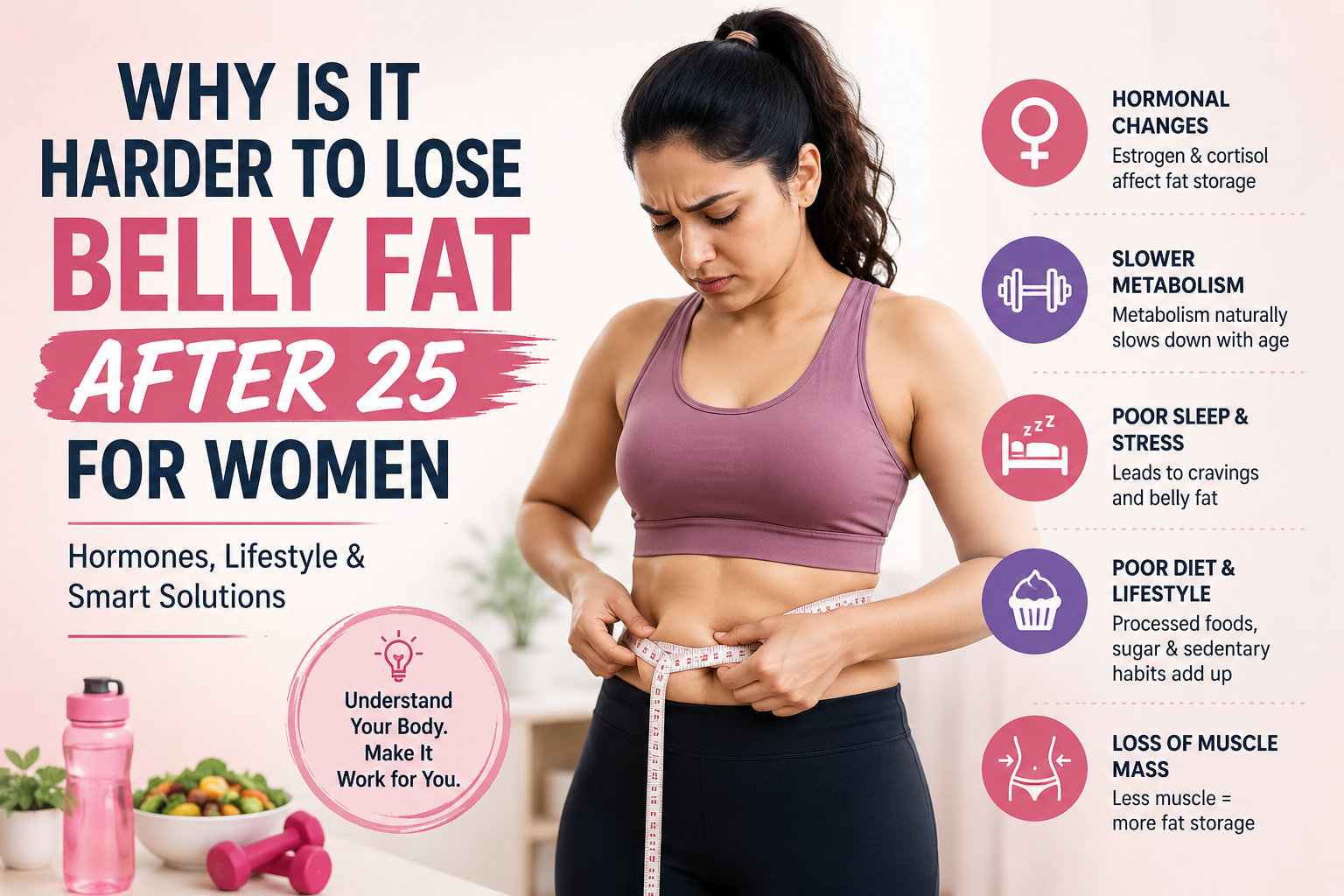
If you’ve noticed that the flat stomach you had in your early twenties seems to have quietly disappeared, you’re not imagining it — and you’re definitely not alone. Many women find it surprisingly difficult to lose belly fat after 25, even when their diet and exercise routine haven’t changed much. This isn’t a matter of willpower. It’s a combination of biology, hormones, and lifestyle shifts that quietly begin around this age and continue for decades.
In this post, we’ll break down exactly why belly fat becomes more stubborn after 25, what’s happening inside your body, and what you can actually do to manage it effectively.
1. Your Metabolism Starts to Slow Down
Around the mid-twenties, your basal metabolic rate (BMR) — the number of calories your body burns just to stay alive — begins a gradual decline. This slowdown is small at first, often just a few percent per decade, but it adds up. The same calorie intake and workout routine that kept you lean at 22 may no longer be enough at 27 or 30.
This is one of the biggest reasons it becomes harder to lose belly fat after 25: your body simply needs fewer calories than it used to, and any extra energy is more likely to be stored as fat, particularly around the midsection.
2. Hormonal Shifts Begin Earlier Than You Think
Most people associate hormonal changes with menopause, but the truth is that hormone levels begin shifting much earlier — often in the mid-to-late twenties. Estrogen plays a major role in determining where the body stores fat. While estrogen levels are higher, fat tends to accumulate in the hips and thighs (often called a “pear shape”).
As estrogen levels gradually start to fluctuate, fat storage patterns shift toward the abdomen, leading to what’s commonly called visceral fat — the deeper, harder-to-lose fat that surrounds your internal organs. This shift is one of the key biological reasons belly fat becomes more prominent and more difficult to lose for women after 25.
3. Cortisol and Stress Play a Bigger Role
Your mid-to-late twenties are often filled with major life changes — career pressure, financial responsibilities, relationships, and sometimes starting a family. All of this adds up to chronic stress, which keeps cortisol levels elevated.
Cortisol is known as the “stress hormone,” and it has a direct link to abdominal fat storage. Elevated cortisol signals your body to store more fat around the belly as a survival mechanism, while also increasing cravings for high-sugar, high-fat comfort foods. Over time, this creates a cycle that makes losing belly fat after 25 significantly harder unless stress is managed alongside diet and exercise.
4. Muscle Mass Naturally Declines
Starting in your mid-twenties, you begin to lose a small percentage of muscle mass each year if you’re not actively working to maintain it. Muscle tissue burns more calories at rest than fat tissue does, so as muscle mass decreases, your metabolism slows even further.
Less muscle means fewer calories burned throughout the day, which makes it easier for fat — especially belly fat — to accumulate and harder to burn off through diet alone.
5. Lifestyle Changes Add Up
Think about how your daily routine has changed since your early twenties. More desk work, less walking, later bedtimes, more eating out, and higher stress levels are all common shifts that happen naturally as life gets busier. None of these changes feel dramatic on their own, but together they create an environment where belly fat accumulates more easily and burns off more slowly.
6. Sleep Quality Affects Fat Storage
Poor sleep doesn’t just leave you tired — it directly affects two key hormones: ghrelin (which increases hunger) and leptin (which signals fullness). When sleep is inconsistent or insufficient, ghrelin rises and leptin drops, leading to increased appetite and cravings, particularly for sugary and high-calorie foods. This hormonal imbalance is strongly linked to increased abdominal fat storage.
How to Lose Belly Fat After 25: Practical Tips That Actually Work
The good news is that understanding these changes puts you in a much better position to address them. Here’s what actually helps:
Prioritize strength training. Building and maintaining muscle mass helps counteract the natural metabolic slowdown. Aim for at least two to three strength sessions per week.
Adjust your calorie intake gradually. As your metabolism shifts, your calorie needs change too. Rather than drastic cuts, make small, sustainable adjustments to your diet.
Manage stress intentionally. Activities like yoga, meditation, journaling, or even short daily walks can help lower cortisol levels and reduce stress-driven fat storage.
Improve sleep hygiene. Aim for 7–9 hours of quality sleep, keep a consistent sleep schedule, and limit screen time before bed to support healthy hormone balance.
Focus on whole foods. Reducing processed foods, added sugars, and refined carbohydrates can significantly reduce inflammation and abdominal fat over time.
Stay consistent, not perfect. Hormonal and metabolic changes happen gradually, so results from lifestyle changes will also take time. Consistency over months — not days — is what produces real results.
Final Thoughts
If you’ve found it harder to lose belly fat after 25, it’s not because something is “wrong” with you — it’s because your body is going through natural metabolic, hormonal, and lifestyle shifts that begin earlier than most people realize. The encouraging part is that small, consistent changes in strength training, nutrition, sleep, and stress management can make a real difference over time.
Understanding what’s happening inside your body is the first step toward working with it — not against it.
This article is for general informational purposes and is not a substitute for personalized medical or nutritional advice. If you have concerns about significant changes in weight or body composition, consider speaking with a healthcare professional.
Read the latest blog here
10 Early Signs of PCOS in Women You Should Know Before It’s Too Late